 Convex finance
 connects boosted liquidity rewards with token staking and governance
Convex finance pools governance-token locks to boost rewards for liquidity providers and distributes protocol income through separate token-staking positions. Its Curve, Frax and f(x) integrations connect deposited assets with different reward contracts. Curve LP deposits, converted CRV and vote-locked CVX have materially different withdrawal conditions. Comparing them means identifying the asset committed, the rewards earned and the asset available on exit. A successful deposit confirms a position; it doesn’t establish a future return.
Bottom line: Convex positions have different exit conditions: withdrawing liquidity, selling a converted token and waiting for a governance lock involve separate mechanisms.
LP Deposits, Token Conversion and CVX Positions
The asset you already hold determines the relevant entry path. A liquidity provider, or LP, holds tokens representing a pool position. Depositing supported LP tokens into Convex connects that position to boosted rewards. Converting a governance token creates a different asset, while staking or locking CVX uses Convex’s native token.
A transferable token can still depend on market liquidity for its exit, and a reward claim doesn’t release locked principal.
| Position | Reward Relationship | Withdrawal Condition |
|---|---|---|
| Curve LP deposit | Boosted CRV and applicable pool incentives | Standard Curve LP staking permits withdrawal without a Convex time lock |
| Staked cvxCRV | Participation in cvxCRV reward distributions | Unstaking returns cvxCRV; conversion doesn’t provide CRV redemption |
| Staked CVX | Platform-fee rewards paid as cvxCRV | The standard CVX staking position permits unstaking at any time |
| Vote-locked CVX | Governance participation and applicable locker rewards | Principal remains inaccessible until the recorded lock expires |
| Frax LP vault position | Pooled veFXS boosting and applicable duration-based rewards | The position’s time lock governs withdrawal eligibility |
Curve Gauges and Pooled veCRV
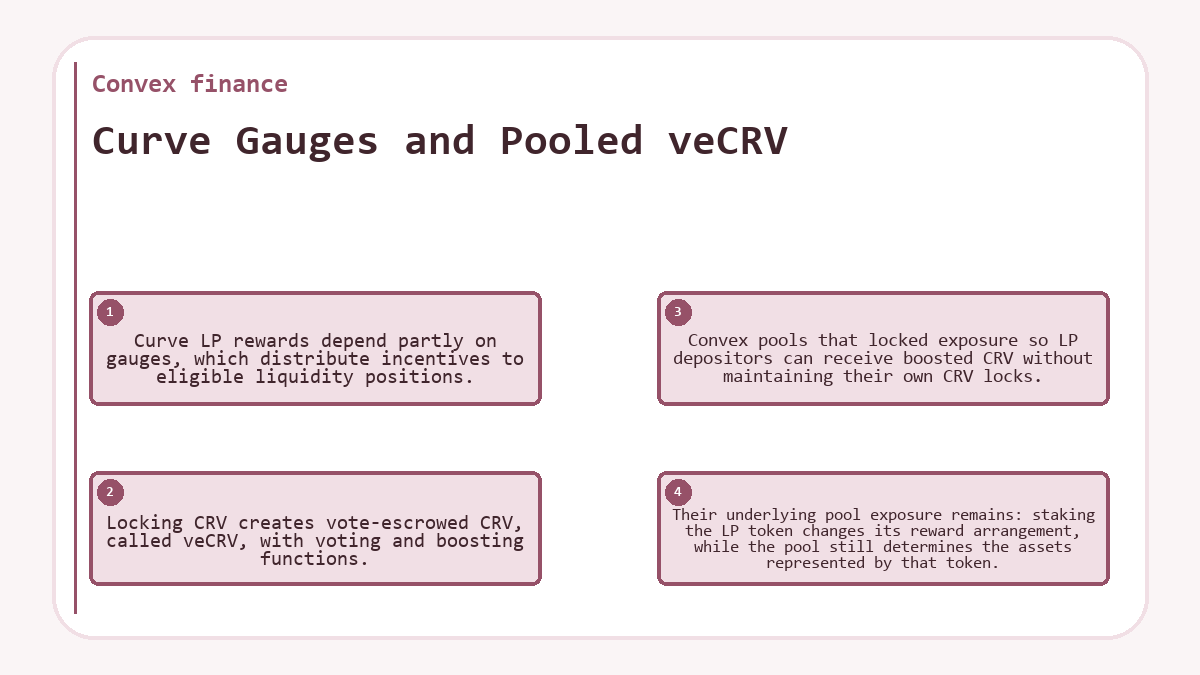
Curve LP rewards depend partly on gauges, which distribute incentives to eligible liquidity positions. Locking CRV creates vote-escrowed CRV, called veCRV, with voting and boosting functions. Convex pools that locked exposure so LP depositors can receive boosted CRV without maintaining their own CRV locks. Their underlying pool exposure remains: staking the LP token changes its reward arrangement, while the pool still determines the assets represented by that token.
cvxCRV Conversion and Reward Preferences
Permanent CRV Commitment
Converting CRV produces cvxCRV at a one-for-one minting ratio. Convex retains the committed CRV in its veCRV position. The minted token provides transferable exposure to that arrangement, with staking available for participation in reward distributions.
Converting CRV into cvxCRV through Convex is irreversible. The minting ratio therefore doesn’t establish a redemption price. A market exchange depends on the liquidity and quote available for cvxCRV.
Separate Reward Allocations
Staked cvxCRV has reward preferences covering crvUSD and governance-token rewards in CRV and CVX. Those preferences affect participation in separate distributions. They don’t promise that the eventual dollar value of the tokens received will match the selected percentage split.
Other stakers’ preferences also affect the allocation of those distributions. Comparing settings therefore requires the associated reward quantities and valuations, rather than treating the preference slider as a fixed portfolio allocation. CVX incentives also remain subject to their minting mechanism.
CVX Staking and Governance Locks
Fee-Earning CVX Stakes
Standard CVX staking earns platform-fee rewards as cvxCRV and permits unstaking without the governance lock. CVX remains the principal asset in that position. Its reward token has separate properties, so earning cvxCRV doesn’t mean receiving additional freely redeemable CRV.
Epoch-Based Governance Participation
Vote locking commits CVX for 16 full weekly epochs, plus the interval before the next epoch begins. The locker records the resulting unlock time. Locked CVX provides voting participation over supported governance allocations, including the direction of emissions. These votes can influence reward distribution; they don’t establish a fixed payment to an individual position.
Frax Vaults and Duration-Based Boosting
Frax LP staking uses personal vaults and individual locked positions. Its pooled veFXS boost is separate from the additional boost associated with the chosen lock duration. A longer commitment changes the duration component without changing the basis of Convex’s pooled veFXS boosting.
The vault’s lock records matter more than a general statement about withdrawing LP tokens. Different deposits can have separate expiry conditions. For the documented Frax staking arrangement, an expired position can remain deposited and continue receiving pooled boosting without renewing its duration commitment. That doesn’t preserve the extra reward associated with an active time lock.
F(X) Rewards and cvxFXN
Convex’s f(x) integration includes boosted liquidity positions and a tokenized governance-lock route through cvxFXN. Depositing FXN for conversion commits it permanently as veFXN and mints cvxFXN one-for-one. Staking cvxFXN provides participation in associated fee distributions. A market swap back to FXN requires an available pool and executable liquidity; Convex conversion doesn’t provide a reverse redemption. This is a separate position from depositing an LP token, even though both belong to the f(x) integration.
Reward Fees and Transaction Costs
Convex fees apply to defined reward streams, rather than automatically taking the same percentage from every deposited asset. In the Curve arrangement, the performance fee applies to CRV revenue. Convex doesn’t take this performance fee from extra Curve pool incentive tokens or veCRV administration fees. Frax and f(x) use their own fee allocations, so one integration’s percentage shouldn’t be applied across the platform.
Standard Curve LP deposits have no Convex deposit or withdrawal fee. Blockchain transaction costs remain separate. Exchanging a reward token or removing liquidity from its original pool can introduce additional costs and price effects. Consequently, a fee-free Convex withdrawal doesn’t imply that every action required to reach a different final asset is free.
Harvested Rewards and Annualized Displays
In Convex’s Ethereum mainnet Curve LP reward arrangement, harvested rewards are streamed over seven days. Current APR reflects active distributions, while projected APR estimates earnings under the pool’s prevailing conditions. Both incorporate protocol fees. Neither display fixes the value of rewards that will accumulate over a future year.
Deposits, withdrawals, gauge boosting and reward-token prices can change the relationship between those figures. A newly entered position participates in the ongoing distribution; it doesn’t acquire a fixed allocation based only on the displayed annual rate. Withdrawing ends participation in subsequent distribution to that position. Accrued claimable rewards and rewards that haven’t yet accrued must therefore remain separate in any earnings comparison. Convex’s sidechain reward pools distribute base gauge rewards when pool actions trigger accounting, without the mainnet streaming delay; extra rewards can use separate timed distributions.
Approvals, Position Balances and Claim Records
Authorization and Deposited Principal
A token approval authorizes a contract to spend tokens within an allowance. It doesn’t create a staked balance. Standard Curve LP and CVX deposits require a separate deposit-and-stake action after any necessary approval. The position record, rather than the approval receipt alone, establishes deposited principal.
A wallet balance and a staking balance describe different locations for an asset. Compare the wallet and staking balances for the same token, network, account and selected position. A lower wallet balance can be consistent with a successful deposit when the corresponding contract position increases.
Claimed Rewards and Transaction Status
A claim concerns accrued rewards, while withdrawal concerns principal. Convex exposes claims for Curve LP positions, staked cvxCRV, staked CVX and vote-locked CVX. Reward accounting needs to distinguish amounts still claimable from amounts already transferred or committed through a selected claim option.
A pending transaction isn’t proof of completion, and a reverted deposit doesn’t establish a stake. If balances appear inconsistent, check whether the deposit transaction succeeded, then compare its token transfers with the relevant staking balance. An approval-only receipt confirms permission to spend; it doesn’t show whether a separate deposit succeeded. Before retrying a reverted deposit, identify and resolve its reported failure, then confirm that no deposit succeeded. Repeating a successful deposit can commit more tokens if the new transaction also succeeds.
Pool Exposure and Contract Dependencies
Convex adds reward contracts to an underlying protocol position. A Curve LP token retains exposure to its pool’s assets and liquidity mechanics. A converted governance token introduces a different exit dependency because its sale price depends on market demand. Reward-token prices can also move independently of the deposited asset, changing the value of an otherwise unchanged token distribution.
Contract audits don’t remove the possibility of losses. Convex positions also inherit relevant risks from integrated protocols, including Curve and Frax. A transaction can complete exactly as requested while the economic value of the position subsequently falls.
Withdrawal Assets and the Final Exit
Withdrawal completion depends on the asset that the selected position returns. A standard Curve LP withdrawal returns the LP token; obtaining its underlying pool assets involves removing liquidity through the pool’s own mechanism. Unstaking cvxCRV leaves cvxCRV available, while a market exchange into CRV introduces a separate execution price. These boundaries explain why similar-looking balances can require different exit operations.
Expired CVX locks remain in the locker until withdrawn or otherwise processed. Expiry establishes eligibility, not delivery to the wallet. Final reconciliation therefore concerns the remaining contract position and the token actually received.
What readers ask about Convex finance
Can Curve LP Tokens Earn Boosted Rewards Without Buying CVX?
Yes, supported Curve LP deposits can receive Convex’s pooled boost without the depositor buying CVX or maintaining a personal CRV lock. CVX ownership serves separate staking and governance functions.
When Does Newly Locked CVX Become Eligible for a Vote?
Newly locked CVX must belong to a completed epoch before a vote starts to participate in that vote. Deposits made during the current epoch don’t contribute to its active voting weight. The timing of the lock relative to the vote therefore matters even when the locking transaction has already succeeded.
Are Expired CVX Locks Subject to a Penalty If Left Idle?
Expired CVX left idle beyond the locker’s grace period can be processed by another user for a bounty. That bounty reduces the amount returned from the affected lock. Each lock has its own grace period, so separate deposits shouldn’t be treated as sharing one expiry deadline.
How Does the CVX Supply Cap Affect Newly Minted Rewards?
The amount of CVX minted per eligible CRV claimed decreases as CVX supply advances through the minting schedule and stops at the maximum supply of 100 million tokens. Eligible CRV claims determine the associated mint amount while supply remains available. Ordinary CVX staking rewards are cvxCRV, so that staking pool doesn’t mint additional CVX through the CRV-claim mechanism.
Does Convex Combine Reward Claims From Multiple Curve Pools?
Convex provides a Claim All option for rewards from multiple Curve LP positions. That option concerns reward collection and doesn’t withdraw the LP principal. Separate reward categories also exist for token stakes and vote-locked CVX, so a combined Curve LP claim shouldn’t be assumed to process every Convex position.
Is cvxFPIS an Active Alternative to cvxFXS?
cvxFPIS was sunsetted following the decision to merge FPIS into FXS governance. It shouldn’t be treated as another active staking choice merely because older descriptions remain accessible. Existing cvxFPIS holdings are covered by the documented migration to cvxFXS on Fraxtal. cvxFXS represents FXS permanently locked as veFXS; staking it earns associated fees, while conversion doesn’t provide redemption back to FXS.