 Convex finance
 accepts supported Curve LP tokens for deposit and staking
Convex finance deposits supported Curve LP tokens into its staking system after the required token approval. Completion means the deposit transaction succeeded and the selected pool credited your position. Record your wallet and staked balances beforehand so you can distinguish permission to spend from an actual deposit.
Key takeaway: A completed LP deposit should reconcile the tokens leaving your wallet with the position credited to the selected pool.
LP Tokens, Deposit Receipts and Staked Positions
Curve LP tokens are the input to this deposit route, while Convex’s Ethereum Booster route uses receipt tokens and reward contracts to account for the resulting position. The LP token represents liquidity already supplied to a Curve pool. Depositing through Convex changes where that token is held and how staking rewards accrue.
On Ethereum, Booster, Convex’s LP deposit contract, supports depositing with or without staking the receipt token. Selecting staking credits the pool’s reward contract for your account. A deposit without staking leaves a deposit receipt in the wallet instead. These outcomes require different balance checks, even though both begin with the same LP token.
Compatibility Before Authorization
The selected Convex pool must accept the exact LP token held by the connected account on the selected network. A similar pool name doesn’t establish that match. Compare the token contract associated with your wallet balance against the token accepted by the deposit position.
A pool’s existence also doesn’t establish that it accepts new deposits. The Booster contract checks whether the system or individual pool is shut down before accepting a deposit. An existing position can therefore remain visible while new deposits are unavailable. Approval cannot overcome that restriction.
Compatibility comes before spending permission. A larger allowance won’t make an unsupported token acceptable.
The Starting Balance Record
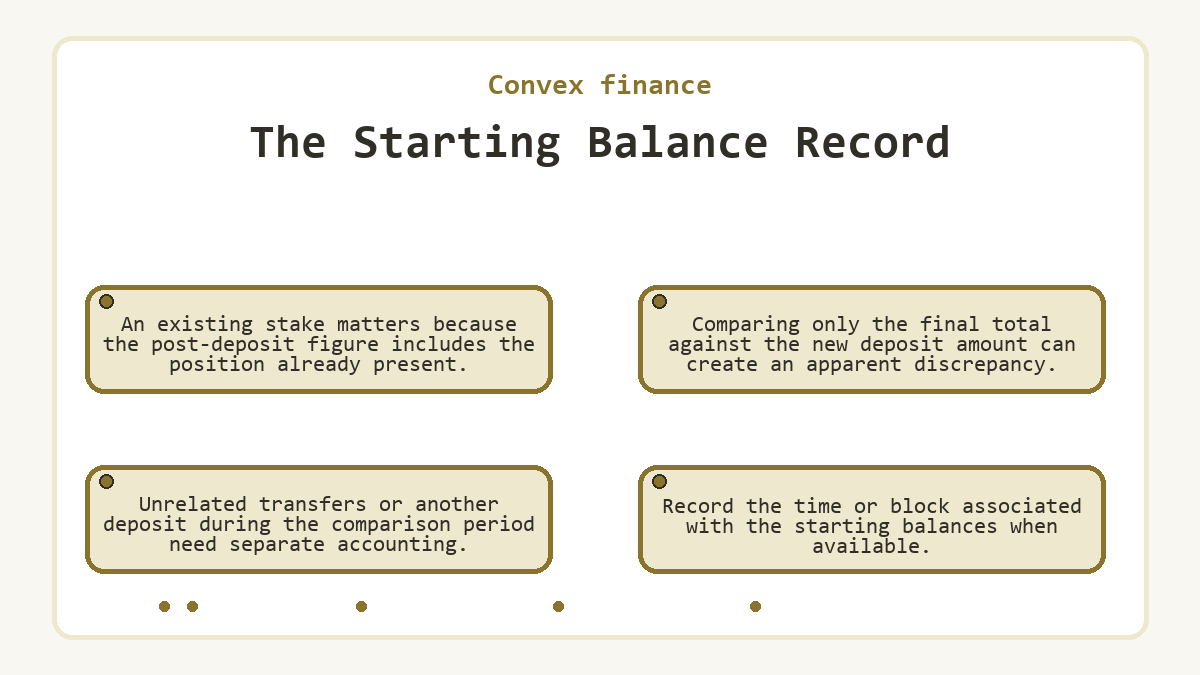
The starting record should identify the connected account, selected network, LP token and existing stake before any deposit changes those balances. Record quantities in token units rather than relying on a combined portfolio valuation. Keep enough displayed precision to compare the amount that you intend to deposit.
An existing stake matters because the post-deposit figure includes the position already present. Comparing only the final total against the new deposit amount can create an apparent discrepancy. Record the time or block associated with the starting balances when available. Unrelated transfers or another deposit during the comparison period need separate accounting.
Approval and Deposit Are Separate Transactions
Token approval authorizes a specified spender to transfer LP tokens within an allowance; the deposit transaction transfers the LP tokens and stakes the receipt tokens if staking is selected. The spender address and approved token must correspond to the selected deposit route. Permission granted to a different contract doesn’t satisfy that requirement.
The documented interface flow requests approval when needed, followed by Deposit and Stake after approval confirms. Existing sufficient allowance can remove the need for another approval transaction. Each wallet confirmation should therefore be read for its actual operation. A successful approval receipt alone doesn’t establish that any LP tokens entered a position.
Transaction Costs Along the Deposit Route
Network execution costs depend on the operations required, the gas that they consume and the applicable fee per gas unit. A route requiring a fresh approval has an additional transaction to fund. An existing allowance may avoid that cost, while preparing LP tokens beforehand introduces separate operations.
For an ordinary Ethereum wallet transaction, gas is paid in ETH. An LP token balance doesn’t supply that gas balance. The wallet’s estimate applies to the proposed transaction; it isn’t a permanent price for every deposit. Executed transactions that fail can also consume gas.
Convex’s Curve LP route has no deposit fee. Charges on CRV reward revenue are separate from the LP principal deposited.
A Compatible Deposit With a Missing Displayed Stake
Assume your wallet holds the exact Curve LP token accepted by the selected Convex pool. You want to stake those LP tokens without converting them into another asset. Before signing, check the following:
- The selected account holds an available balance of the required LP token.
- The token and deposit position belong to the same network.
- The selected pool accepts new deposits.
- The proposed action includes staking, with the intended amount and spender.
- The wallet can fund the estimated approval and deposit costs where both are required.
Record the available LP balance and existing stake, then complete the required approval followed by the deposit-and-stake transaction. Your execution costs depend on which transactions are required and the fees they incur.
With no intervening activity, the expected comparison is a lower wallet LP balance and a corresponding increase in the pool’s credited stake. Compare both changes with the deposited quantity. A portfolio’s currency value isn’t the measure for this reconciliation.
Suppose the deposit transaction receipt reports success, but the interface still shows the previous stake. Read the selected reward contract’s balance for the same account, using a block at or after the deposit. A matching contract balance identifies a display discrepancy.
If that contract balance also fails to match, stop before submitting another deposit. Confirm the pool, recipient and staking choice recorded in the transaction. The original expectation no longer applies if the operation deposited without staking or credited a different account.
The Receipt Behind a Successful Deposit
A transaction receipt establishes whether execution succeeded and identifies the block containing the transaction. A transaction hash alone can exist while submission remains pending. Keep the approval hash separate from the deposit hash so their statuses can’t be confused.
In the standard Booster flow, the deposit event records the user, pool identifier and amount. The reward contract separately records staking. Check the emitting contract as well as the event label: a familiar label alone doesn’t identify the intended position. These records connect the submitted amount to the balance that the account should hold.
Token Units and Reward Balances
The standard Convex reward contract records each account’s staked amount separately from its earned rewards. A newly credited stake doesn’t require an immediately visible reward amount. In Ethereum’s BaseRewardPool, accrual depends on the reward distribution and elapsed time.
Token displays can also round quantities or format their decimal places differently. Compare equivalent units before treating a small displayed difference as missing principal. A change in the currency valuation of an LP position doesn’t, by itself, show that its token quantity changed.
Records That Remain Useful After Confirmation
The deposit record should retain the account, network, LP token identity, pool, deposited quantity and transaction receipt. Keep the starting and resulting balances alongside it. That record supports later reconciliation when an interface changes its presentation or another deposit increases the position. Successful staking confirms where the LP position is recorded; it doesn’t establish the value of the underlying pool assets or the rewards that future distributions will deliver.
Convex finance FAQs
Can I Deposit LP Tokens That Are Already Staked in a Curve Gauge?
The direct wallet deposit route requires available LP tokens in your wallet. Tokens already committed to a Curve gauge aren’t part of that available balance. They must first be released through the applicable gauge withdrawal operation before the wallet can supply them to the Convex deposit route.
Must I Approve Unlimited LP Token Spending for a Deposit?
An unlimited allowance isn’t required for a standard deposit of a specified amount. The allowance must cover the amount that the deposit contract will transfer. A limited allowance can require another approval for a later deposit, while a larger remaining allowance continues to authorize that spender.
Does Revoking LP Token Approval Remove an Existing Convex Stake?
Revoking an LP token allowance doesn’t withdraw an existing stake. The allowance controls future transfers from the wallet by the approved spender. The deposited position has separate contract accounting, so releasing that position requires the appropriate withdrawal operation rather than an approval change.
Will a Direct LP Token Transfer to a Contract Create a Staking Position?
A plain token transfer doesn’t perform the Convex deposit-and-stake operation. Position accounting relies on the deposit and staking functions executing. Sending tokens directly to a contract address can therefore leave them without the position credit that the intended deposit route would create.
Can I Deposit Only Part of My Available LP Balance?
The standard Curve LP deposit flow accepts a specified quantity, so it can use less than the available wallet balance. The selected amount must remain within both the spendable balance and applicable allowance. Tokens left in the wallet remain outside that new Convex stake.
How Long Can a Deposit Remain Pending After Wallet Confirmation?
Wallet confirmation doesn’t set a fixed completion time. The transaction still needs network inclusion, which depends on its fee settings and network conditions. A pending transaction has no successful execution receipt yet, so elapsed time alone cannot establish a completed deposit.
Are LP Tokens Deducted When the Deposit Transaction Reverts?
A reverted standard deposit transaction rolls back its token transfers and staking changes, although execution can still consume gas. An approval completed in an earlier transaction remains separate and can stay in effect. The failed deposit therefore doesn’t imply that the previous spending permission disappeared.